


Alberta is expected to see the biggest salary increases in Canada next year


Employees hoping for a significant salary increase in Alberta next year shouldn’t hold their breath, but they can take some comfort knowing the province is still expected to lead the country in wage growth.
Eckler, an actuarial consulting firm, released the results of its Compensation Planning Survey on Thursday, revealing the continuing trend of slowing salary growth across the Canadian market.
The survey was conducted from July to August 2025, with responses from over 500 Canadian organizations across diverse sectors. It found employers are planning average base salary increases of 3.3 per cent for 2026 (excluding freezes), down slightly from 3.4 per cent this year.
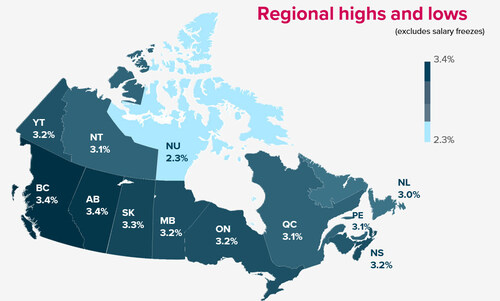
Alberta and British Columbia are expected to lead the country with 3.4 per cent increases, followed by Saskatchewan (3.3 per cent). Ontario, Manitoba, New Brunswick, Nova Scotia, and Yukon are expected to see a 3.2 per cent increase.
At the same time, Quebec, P.E.I., and the Northwest Territories are projected to fall below the national average, with Newfoundland and Labrador and Nunavut forecast to see the lowest bumps, at three per cent and 2.3 per cent, respectively.
CNW Group/Eckler Ltd.
Employers tighten budgets
Eckler said the dip reflects a more cautious approach amid economic uncertainty and stabilizing inflation.
“Employers are signalling that while the economy has cooled, the war for talent is not quite over,” said Anand Parsan, principal at Eckler. “Only five per cent of employers are considering salary freezes, and while 29 per cent remain undecided, most are planning similar or lower salary increases compared to 2025.”
- You might also like:
- Goodbye, Wild Rose Country: Alberta is changing its licence plate slogan
- University of Alberta breaks the global top 150 in prominent ranking
- Alberta Health Services cuts 100 positions in corporate roles
The report stated that while the Bank of Canada cut interest rates in an attempt to ease borrowing costs and stimulate growth, rising unemployment and ongoing economic uncertainty are keeping employers conservative.
“Trade tensions between Canada and the U.S. are also contributing to financial uncertainty, prompting employers to balance cost control with the need to reward and retain key talent,” added Parsan.
According to the survey results, this decline in salary increase marks the third consecutive year of slowing salary growth across sectors in Canada.
Salary increases by industry
The sectors projected to receive the highest salary increases in Canada include professional services (3.7 per cent), agribusiness/agriculture and banking/insurance (3.6 per cent).
Government, IT/high-tech, real estate, utilities, construction, retail, manufacturing, member associations, and transportation are expected to see moderate raises ranging from 3.2 per cent to 3.4 per cent.
The lowest wage increases are expected to go to charities, foundations, energy/oil and gas (three per cent), as well as education and healthcare (2.9 per cent).
With files from Isabelle Docto