


Vancouver rentals require sky-high wages for the average one-bedroom


If you’re looking at Vancouver rentals, you’ll need to earn almost $40 an hour just to afford a one-bedroom apartment.
That’s the sobering reality laid out in a new report from the Canadian Centre for Policy Alternatives (CCPA), which ranks Vancouver as the least affordable city in Canada for renters.
For context, the B.C. government says the average hourly wage in the province is about $34.
On paper, that doesn’t sound too far off.
But averages don’t always reflect everyday reality — how many people do you actually know who are making $34 an hour or more?
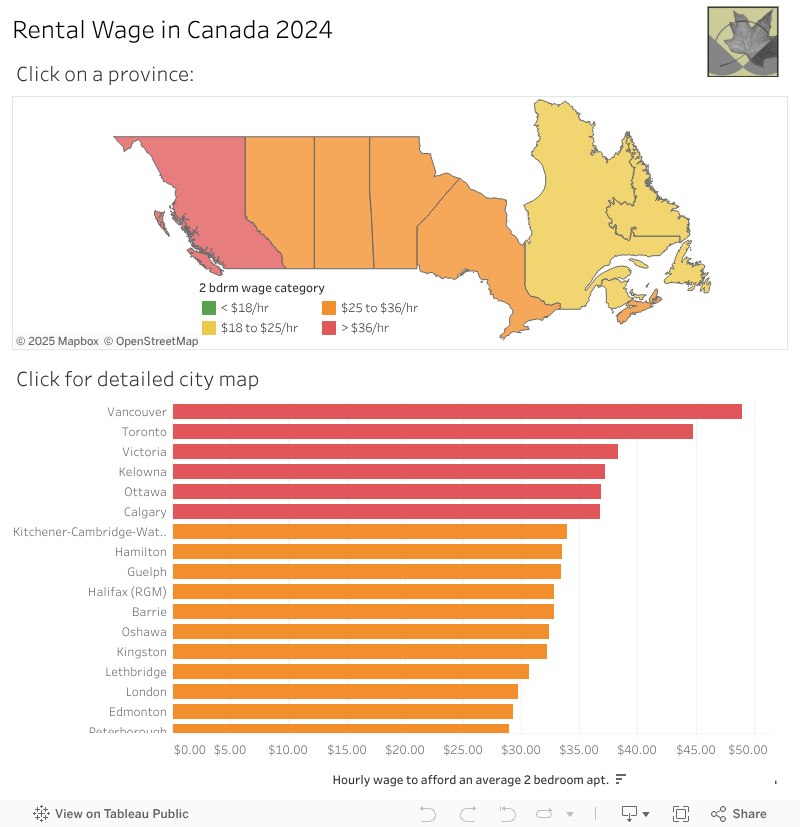
According to 2024 data, someone in Vancouver must earn $37.84 an hour to afford a one-bedroom apartment, or nearly $48.94 for a two-bedroom apartment, equivalent to more than $78,000 per year.
And that’s just based on average rents.
According to Statistics Canada data cited in the CCPA report, asking rents for vacant units in Vancouver are even higher, $2,380 for a one-bedroom and $3,170 for a two-bedroom.
That means new renters would need to make $46 an hour for a one-bedroom, or $61 for a two-bedroom.
B.C. currently has the highest minimum wage in Canada at $17.40 an hour, but it’s not even close to covering the cost of rent in Vancouver.
The CCPA points out that in cities like Vancouver, Toronto, and Calgary, the rental wage for a one-bedroom is more than double the local minimum wage.
That means workers making minimum wage face a stark reality: either take on multiple jobs, live behind curtains, or pay far more than they can afford in rent.
Vancouver isn’t the only B.C. city struggling with sky-high rental wages.
Rentals in other B.C. cities, such as Victoria and Kelowna, also show rising costs, although not as extreme as those in Vancouver.
Victoria and Kelowna also rank among the most expensive in the country, with hourly wages between $29 and $38 needed for a modest apartment.
The study found that out of 62 cities surveyed, only eight, most of which are in Quebec, had one-bedroom apartments affordable for someone working full-time at minimum wage.
Looking for a new place makes the situation even worse.
The report highlights that market rents for vacant or unoccupied apartments are much higher than the averages.
Rents in Canada remain unaffordable for low-to-moderate income households, costing in some cities more than what two people, making minimum wage, can earn together. New @ccpa report by @MarcLeeYVR and @DavidMacCdn breaks down the issue. #canlab https://t.co/pmMoqvPN0k. .
— @policyalternatives (@ccpa) September 4, 2025
In Vancouver, the so-called moving penalty works out to $46 an hour for a one-bedroom and $61 an hour for a two-bedroom, based on Statistics Canada’s most recent data.
This keeps many renters locked into their current homes and discourages people from relocating for job opportunities or family needs.
What the report says should change
The CCPA argues that raising minimum wages alone won’t solve the crisis, since rental wages in big cities range from $30 to $60 an hour.
Instead, the authors say governments need to boost renter protections, introduce stronger rent controls, and build more non-market and publicly owned housing.
“Too many households spend more than a reasonable share of their income on rent, compromising their ability to pay for food, transportation and other necessities,” wrote report authors Marc Lee and David Macdonald.
You can read the full report and explore its interactive rental wage map on the CCPA’s website.
Want to stay on top of all things Vancouver? Follow us on X