


Vancouver was one of the first Canadian cities to see Japanese cherry trees


Vancouver is on the cusp of spring, with budding cherry blossoms peeking out from the freezing rain and the city’s largest cherry blossom festival yet lined up for April.
A symbol of relief from the dreariness of winter and spring renewal, cherry blossoms have become a huge part of the city’s cultural fabric and natural allure. But before we dive into all the incredible planned festivities at this year’s Vancouver Cherry Blossom Festival (VCBF), it’s worth tracing the city’s history of cherry trees back to the very beginning, exactly 100 years ago.
The story of Vancouver’s sea of pink starts here!
Where did cherry blossoms originate?
Flowering cherry trees are often referred to as cherry blossoms and are considered the ornamental versions of their fruit-bearing predecessors. However, some types of ornamental cherry trees produce small cherries that feed a variety of birds in the summer months.
Today, there are over one hundred cherry tree varieties in Japan, with the large majority cultivated by humans for hundreds of years for decorative use in gardens and parks, according to japan-guide.com.
“By far the most popular cherry tree variety today is the cultivated Somei Yoshino.”
Known in Japan as sakura, these flowering cherry trees are revered across the globe for their delicate yet vibrant beauty, an emblem of Japan’s rich history, culture, and identity. According to the Japan National Tourism Organization (JNTO), sakura were originally used to mark the year’s harvest, symbolizing hope and renewal.
Sakura are typically in full bloom for one week every year between March and early May, making it all the more magical. The beautiful-yet-fleeting period is celebrated with viewing parties called “hanami,” after which point the small flowers flutter down from their trees, petal by petal, says JNTO.
Similarly, Vancouver’s cherry blossoms come in waves, with varying peak blooms depending on the variety. But how did they get here?
The first cherry trees in Canada
A representative of the VCBF confirms that Vancouver was “one of the first places in Canada to receive cherry trees from Japan.” After crossing an entire ocean in 1925, the mayors of Kobe and Yokohama presented them as a gift to the Vancouver Park Board. As stated by the VCBF, 500 trees of the Ojochin variety were gifted for planting at the cenotaph in Stanley Park in honour of the many Japanese Canadian veterans of WWI.
“The 1930s through the ’50s saw Park Board staff sowing cherry tree seeds in significant numbers thanks to contributions from Japanese Canadians,” reads the festival’s website. “These varied significantly from the usual trees on Vancouver’s boulevards and in parks, which had taken the form of large, stately trees like elms, maples, chestnuts, and planes since the 1800s.”
Since then, cherry blossoms have taken over the minds, hearts, and streets of Vancouver.
They also serve to commemorate the forced internment of 22,000 Japanese Canadians in 1942 and the injustice they suffered. A few years prior, in 1935, local business owners and philanthropists Bunjiro and Kimi Uyeda donated an additional thousand cherry trees in anticipation of Vancouver’s golden jubilee. However, they never got to see them grow, as it wasn’t until April 1942 that the cherry trees were planted — just months after the family was forcibly relocated to Kaslo, B.C., along with so many others.
Today, Vancouver’s cherry trees signify the resilience and generosity of Japanese Canadians and the Japanese government.
When will the cherry blossoms bloom in 2025?
Good news for cherry blossom aficionados! Vancouver is currently in full bloom, and if you’re wondering where to spot the pink canopies, you can check out the Vancouver Cherry Blossom Festival’s interactive map:
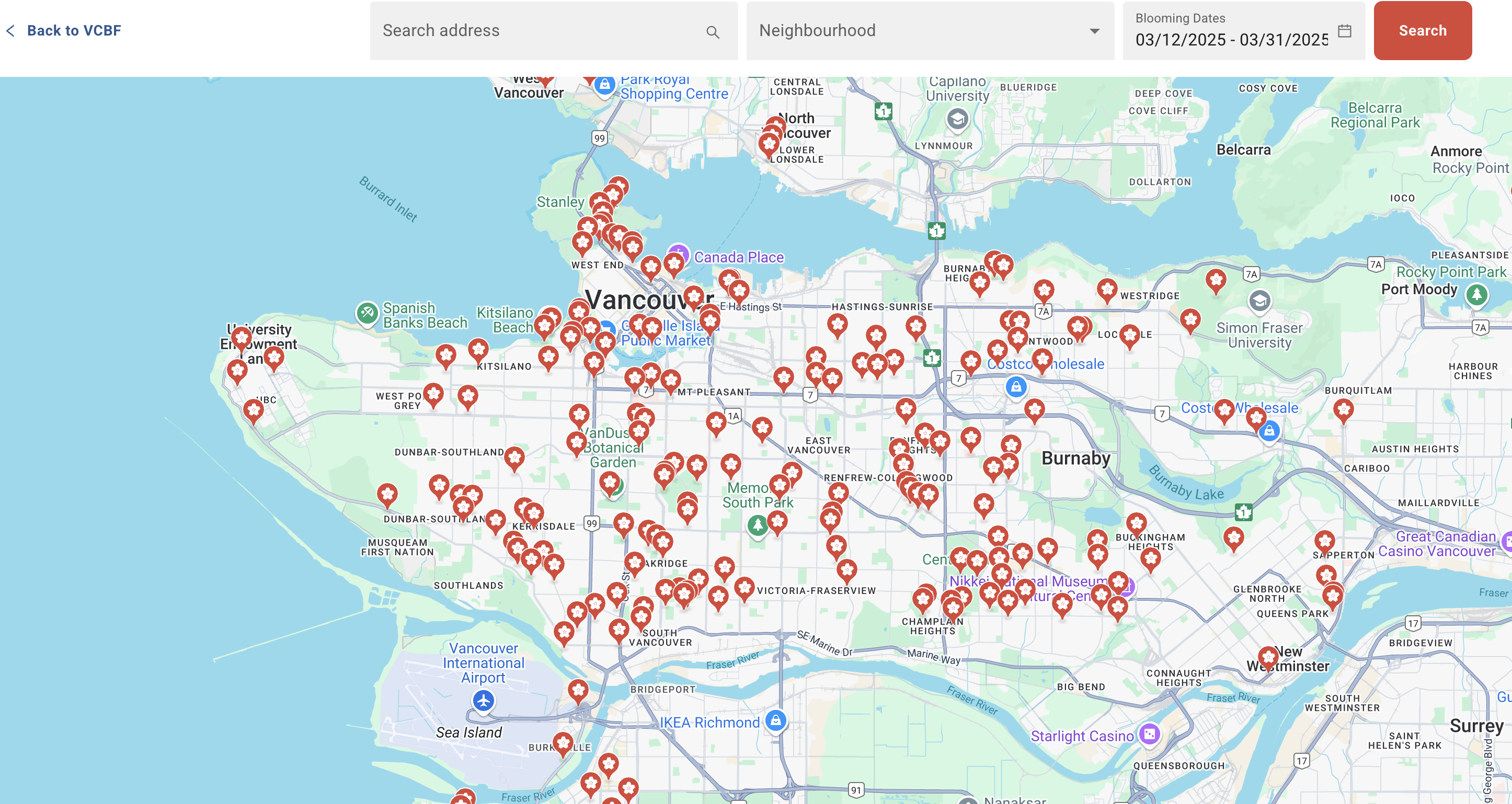
Those who navigate to the VCBF map can search by bloom date or neighbourhood throughout the season.
The “biggest Vancouver Cherry Blossom Festival yet”
The Vancouver Cherry Blossom Festival still has a few days of events to check out.
On April 12 and 13, the two-day Sakura Days Japan Fair will take over VanDusen Botanical Garden, bringing together a mix of Japanese traditions, including live performances, culinary offerings, and Japanese theatre and crafts.
And fingers crossed that Bike the Blossoms will be back after its cancellation last year! Stay tuned for more info on festival programming to come.
Viewing tips

Photo via Shutterstock
Ready to bookmark some of the most stunning trees and spots for cherry blossoms? Here are just some of the 500+ “favourited” spots on the festival map to check out as each variety blooms:
- Shaughnessy – Accolades in Angus Park on Angus Drive and Alexandra Street
- Umineko trees on Sophia at 20th Street, near Edward Park
- Several Akebono to the right as you enter Queen Elizabeth park on 33rd from Cambie Street
- A dozen Shirofugen in the cemetery near 41st Street and Fraser Street
- Fairview – Several Ukon on a mound at Charleston Park at False Creek
- More than 100 Akebono trees at Gary Point Park, Richmond
- West End / Stanley Park – a grove of Akebono on the lower side of the Rose Garden in Stanley Park
Destination Vancouver adds that Queen Elizabeth Park, VanDusen, and Nitobe Memorial Garden at UBC are among the most popular spots for viewing the cherry blossoms. So, if you’re hoping to snap a photo at one of these hotspots, make sure you plan accordingly.
As always, remember to respect the environment and nearby residents during your photo ops, refrain from climbing any trees, breaking off branches, or stopping in the middle of the street. The lure of a beautiful cherry tree in full bloom is hard to quell, but there are ways to enjoy the season without causing disturbance.
So come rain or shine (but probably more rain…), it’s time to experience the magic that is the very beginning of cherry blossom season.
Enjoy, Vancouver!