

This city is the safest in Canada, according to latest poll


According to a new poll, one Canadian city has been ranked the safest in the country — but the final results were neck-and-neck.
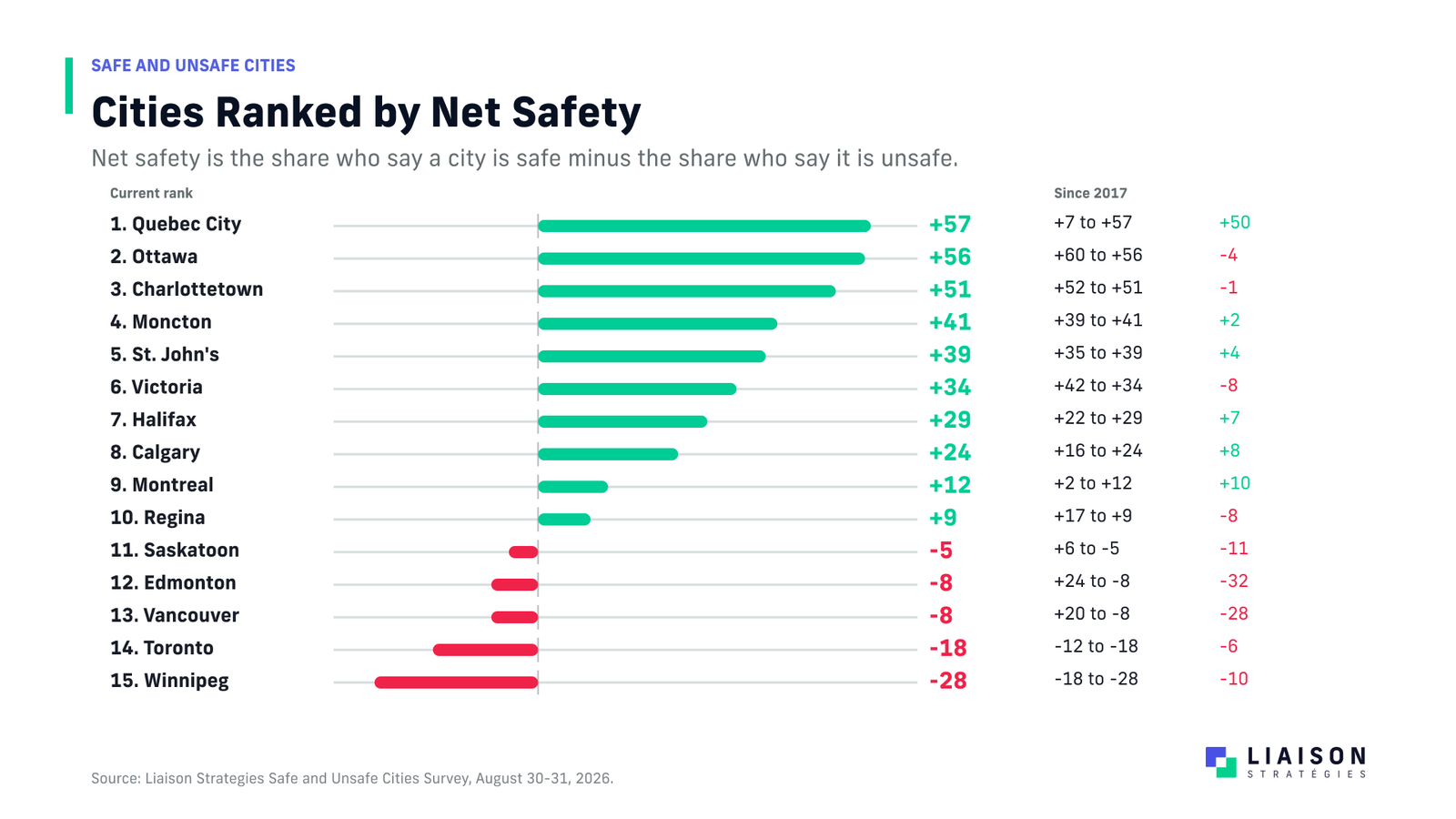
Quebec City narrowly edged out Ottawa for the top spot in a new study from Canadian polling firm Liaison Strategies, with just a one-point difference separating the two cities on the poll’s net safety score.
Liaison Strategies asked 1,500 Canadian adults how safe or unsafe they believe 15 Canadian cities, including Calgary, Toronto, Vancouver and Halifax, actually are. They were asked whether they considered the cities very safe, somewhat safe, somewhat unsafe, very unsafe, or whether they do not know enough to say.
Here’s where things get a little interesting.
Ottawa actually had the highest percentage of respondents who said it was safe, with 75 per cent calling the capital city very or somewhat safe. Quebec City was close behind, at 74 per cent.
But when the firm factored in both positive and negative perceptions of safety, Quebec City came out on top, because net safety subtracts the percentage of respondents who consider a city unsafe from the percentage who do consider it safe.
Liasion Strategies
“This is a two-city story,” said David Valentin, principal at Liaison Strategies. “That is a very narrow gap, but if we are ranking cities by net safety, Quebec City is first.”
At the other end of the ranking, five cities had negative net safety scores: Saskatoon, Edmonton, Vancouver, Toronto, and Winnipeg, the latter finishing last at -28.
“Winnipeg is the clearest safety concern,” said Valentin. “It also has the highest official Crime Severity Index among the cities tested, so in Winnipeg the perception problem and the official data are pointing in the same direction.”
Valentin noted that Toronto is perceived as “almost as unsafe as Winnipeg,” but official crime-severity data does not place the city in the same category. He said that makes Toronto the clearest example in the report of a gap between a city’s safety reputation and its official crime data.
Interestingly, Valentin also noted that only 12 per cent of Canadians surveyed said crime statistics are the main thing shaping their impression of how safe a city is.
“If people are mostly relying on news coverage, personal experience, and word of mouth, then city safety is not just a policing issue. It is also a reputation issue.”
He also pointed to what he described as a “clear gender gap,” as women see a sharper safety problem in several major cities like Winnipeg, Vancouver, Edmonton, and Toronto.
Liaison Strategies says it is one of Canada’s most accurate polling firms, ranking first in accuracy in the 2025 Ontario election and second nationally in the 2025 federal election. The firm is also a member of the Canadian Research Insights Council.
Visit its website to read the full study on the safest cities in Canada.