


Four historic Alberta settlements were built by Black immigrants


As we say goodbye to February and Black History Month, we’re taking a look back at four Black settlements in Alberta that shaped our history.
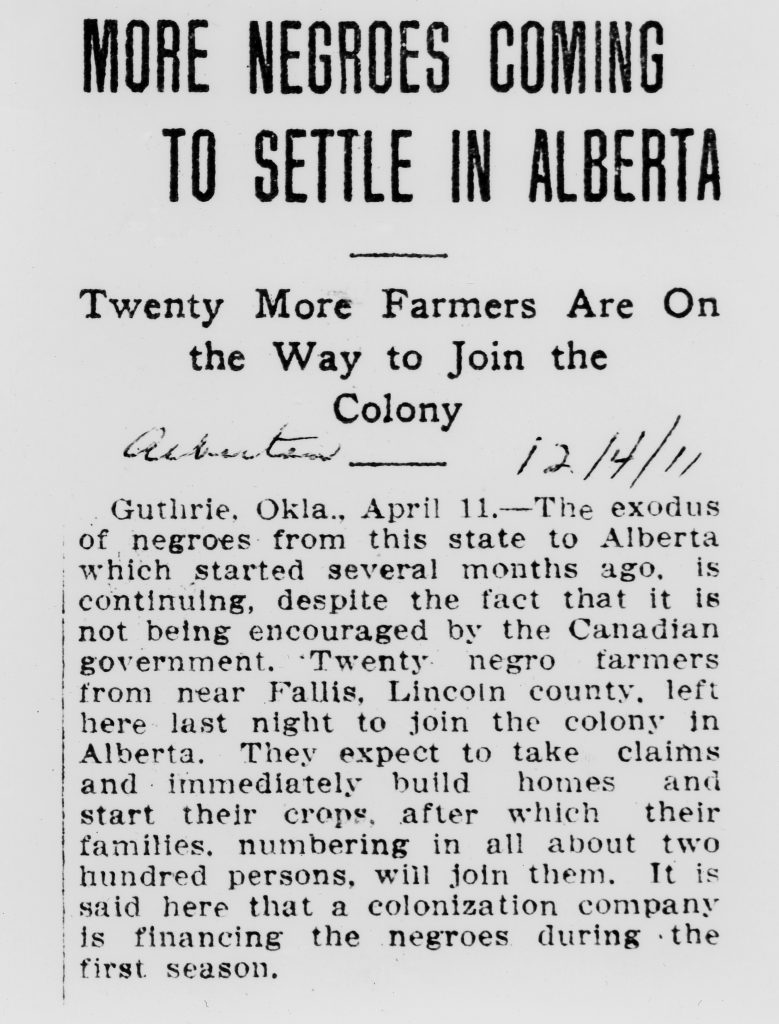
In the early 1900s, a wave of African Americans left the U.S., looking for a way out of racism and segregation. Many came from Oklahoma, where statehood in 1907 only made things worse. Alberta offered a chance to start over.
Jennifer Kelly, professor emeritus at the University of Alberta and author of a history of early Black settlement for the Edmonton City Museum project, explains that despite immigration barriers, these settlers built four communities that left a lasting mark on the province.
Glenbow Archives, Archives and Special Collections, University of Calgary [NA-3556-4a]
“So there was a whole sort of infrastructure that was developed, you know, and going out, encouraging people to come as immigrants, and then seeing them get they had to prove by improving the land in some ways, so that often took longer than realized… But they really wanted immigrants who were racialized as white because they had an underlying white supremacist logic to it,” she said.

“Aerial view of J. D. Edwards farm, Amber Valley, Alberta.” [ca. 1940s], (CU1153713) by Unknown. (Courtesy of the Collection, Libraries and Cultural Resources Digital Collections, University of Calgary)
In April 1908, the first group of Black settlers arrived in Edmonton and settled in Junkins (now known as Wildwood). These families worked hard, building homes, schools, and churches, setting the foundation for future generations.
The four main Black settlements in Alberta were Junkins, Keystone (now Breton), Campsie (near Barrhead), and Pine Creek (later Amber Valley). Of these, Amber Valley became the largest and best-known. These communities were often mentioned in early 20th-century newspapers and became key parts of Alberta’s history.

Google Maps
Black settlers built relationships with other nearby immigrant groups and had connections with Indigenous communities that shaped their experiences in Alberta. In places like Junkins, cooperation was common — Scandinavian settlers lived nearby, and the communities often leaned on each other for support.
“The impression that’s given is that people generally got on. I mean, you’ll always have people who are racist, so you’ll always have those incidents,” said Kelly.
“But on the whole, they seem to think that the experiences within the communities themselves, where people knew families, and maybe it’s because they knew families that they were not as racist. So once they left the communities, then things did change.”
By 1911, 30 per cent of Alberta’s Black population lived in urban areas such as Calgary and Edmonton, and by 1921, the Black population continued to grow, reaching 277 people in Edmonton alone. That year, 74 per cent of American-born Black immigrants had become Canadian citizens.
Farming was the main occupation for the settlers, but in winter, many took work in construction or meatpacking. These communities built institutions like the Good Hope Baptist Church in Keystone and the Grace A.M.E. Church in Junkins, which served as cultural hubs.
Around the time of the Great Depression, many Black families moved away from the settlements and into Calgary and Edmonton for better job opportunities. The Amber Valley post office closed in 1968, and the school shut down in the 1950s.